

How Trump’s Approval Stacks Up Against Modern Wartime Presidents
Since the start of Operation Epic Fury, President Trump’s approval has fallen to second-term lows. While the onset of past wars has often produced brief approval rallies, conflicts marked by uncertainty and economic pressure have instead led to declines in approval.
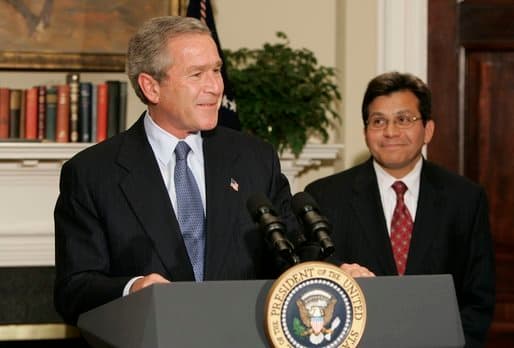
The most direct comparison to Operation Epic Fury is Operation Iraqi Freedom, when the United States invaded Iraq to overthrow Saddam Hussein under President George W. Bush. Shortly after the operation began on March 20, 2003, Bush’s approval spiked from 57% to 71.3% in early April. Just over one month into the conflict, on May 1, when Bush declared “Mission Accomplished” and that “major combat operations in Iraq have ended,” he had 67.5% approval in the RCP Average.
Only later, after the conflict continued, insurgency developed, and an end to the conflict became uncertain, did his approval fall significantly, dropping to 51% at the time of the 2004 election and 27.8% in November 2008, when Bush signed a deal stipulating that all U.S. troops would be out of Iraq by 2011.
During the administration of Barack Obama, Operation Inherent Resolve, which was aimed at destroying the terrorist group ISIL, saw a much more muted reaction. Following the initial airstrikes in mid-September 2014, his approval was largely unchanged in the months that followed, staying around 42% from mid-September through November. Throughout the rest of his term, as operations expanded, his approval gradually rose, reaching about 45% in early 2016 and around 54% in January 2017.
A more recent conflict that did not directly involve U.S. strikes but featured hundreds of billions in U.S. support was the Russia-Ukraine war, which began in February 2022 and similarly did not produce a wartime rally. In the month after the conflict began, President Joe Biden’s approval did not change much, remaining around 41.5% from late February through mid-May. However, a significant decline came in the summer, when inflation hit 9%, in part due to rising gas prices tied to the war. This pushed Biden’s approval down to a term low of 36.8%.
If Trump has any hope of approval recovery, it would be if his approval reacts similarly to George H. W. Bush’s during the Gulf War. After Iraq invaded Kuwait, Bush’s Operation Desert Shield began the buildup of troops in Saudi Arabia to both deter Saddam Hussein from invading Saudi Arabia and prepare for offensive operations against Iraqi forces. However, during the period between August, when Iraq invaded Kuwait, and the start of offensive operations in Operation Desert Storm, Bush’s approval fell from 74% in August to 54% in November, according to Gallup. This was partially due to uncertainty in the region, as well as an oil price spike, during which the price of a barrel of oil doubled from around $17 to the high $30s.
However, once Operation Desert Storm began and the U.S. launched strikes and pushed back Iraqi forces, that decline quickly reversed. Bush’s approval surged from 64% in a Jan. 11–13 poll to 82% in a Jan. 17–20 poll after the operation began. Just over one month later, after a ceasefire was negotiated and agreed upon, it rose even further to 89% in a Feb. 28–March 3 poll.
Since the Iran war began, Trump’s approval has fallen from 43.5% to second-term lows of around 40.9%. If oil prices continue to rise, as they have during past Middle East conflicts, and the war drags on for months, a further drop of 5 to 15 points is a strong possibility. However, if the conflict ends with a favorable ceasefire, the bleeding is likely to stop.
State of Union
.