

New Poll Highlights Popularity Among PA’s Leaders
In our first survey of Pennsylvania politics, the RealClearPolitics Institute of News & Information (RCPINI) partnered with Emerson Polling to explore issues of social trust in southwestern Pennsylvania. We are back now with our second survey. In this edition, we survey 2,000 Pennsylvania voters to examine attitudes toward data centers, artificial intelligence, and energy. This large sample enables us to increase our confidence in our findings compared to a typical public poll. We also broaden our scope to Pennsylvania as a whole.
First, though, we wanted a survey of the general “lay of the land” in the Keystone State. Which politicians are perceived as succeeding? Which are flailing? We surveyed approval ratings for three very different politicians: Josh Shapiro, the Democratic traditionalist and governor; John Fetterman, the quirky Democratic outsider; and David McCormick, the recently elected Republican senator.
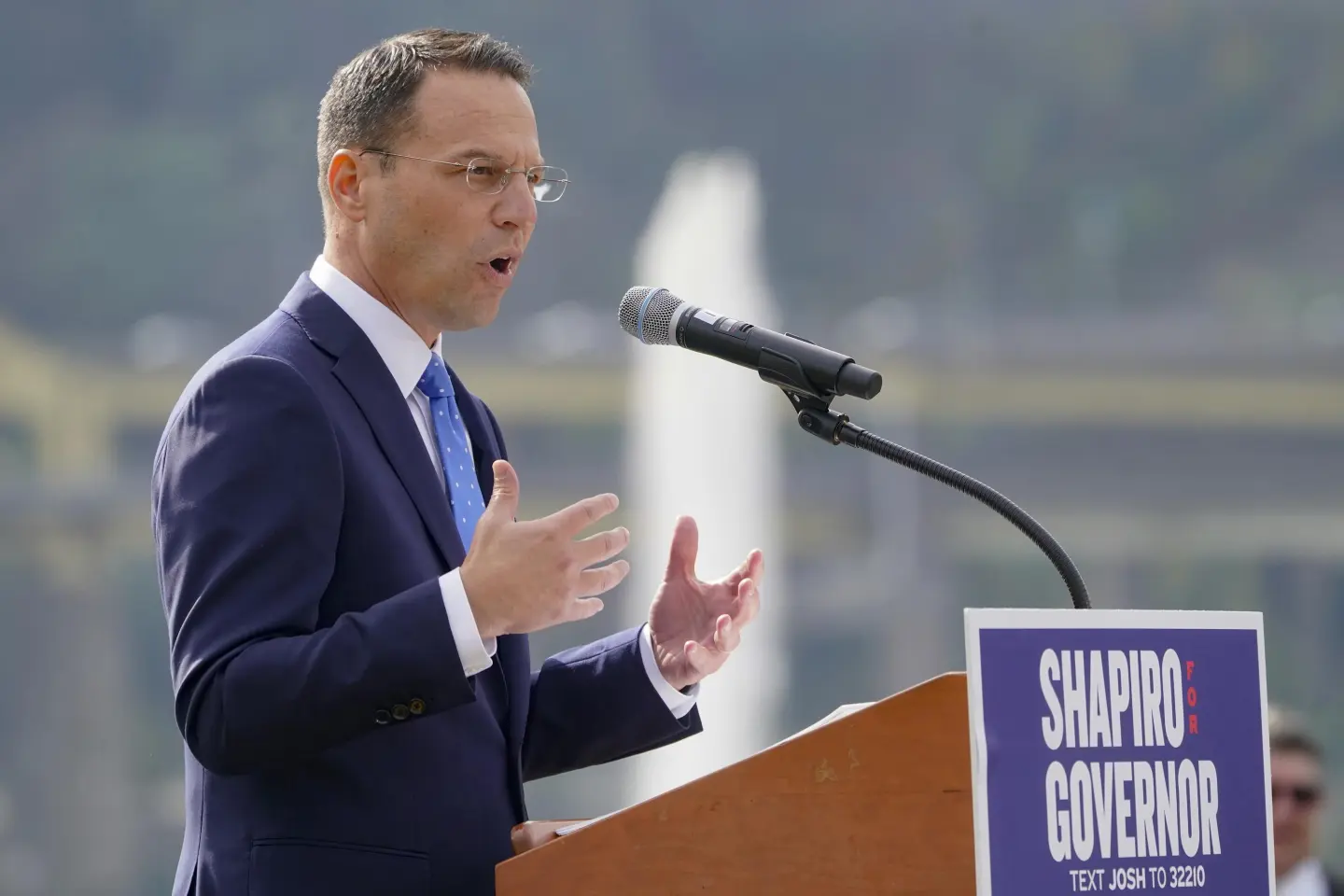
Shapiro remains a popular governor with widespread approval. In the survey, 49% of Pennsylvanians approved of the job he was doing, compared with just 22% who disapproved. Rounding this out, 26% are neutral, while 4% report never having heard of him (Note: numbers may not add up to 100% due to rounding).
Shapiro’s popularity is surprisingly broad for a politician in our highly polarized age. Among 18-29 year olds, he stands at 42% approve/10% disapprove. His net job approval is almost as high among people over the age of 70, where he stands at 61% approve/29% disapprove. Among men, his job approval is 51%-26%; among women, it is 47%-17%.
The education gap in Pennsylvania, however, is massive. Among those with a high school degree or less, Shapiro is still popular: 40%-21%. But for those with a college degree, it stands at 58%-24%. With a post-graduate degree? 66%-20%. When it comes to race, however, his job approval rating is stable: 26%-4% among Asians, 49%-25% among whites, and 56%-6% among blacks. Even among Republicans, he stands at 29%-42%. Unsurprisingly, Shapiro is upside-down, but those are surprisingly strong numbers for a Democrat in our polarized age. Consistent with this, Shapiro has the highest job approval in Southwestern and Southeastern Pennsylvania, and performs the worst in north-central Pennsylvania, albeit modestly so.
John Fetterman is a different case. His job approval is highest among people in their 60s, and weakest among 30-39 year olds, where he is actually upside-down at 32%-36%. He’s net positive with both men and women.
The education gap, however, is astronomical. Among voters with a high school degree, he is positive, at 39%-25%. For college graduates, however, he is slightly upside-down, 39%-40%, well within error margin territory. Among those with a postgraduate or advanced degree? He’s underwater by an astonishing (for a Democrat) 33%-53% range.
Like Shapiro, Fetterman is popular with voters of most races, though they are fairly tepid across the board; typically in the mid-single-digits-to-low-teens. He’s at 33%-22% among Hispanics, 41%-37% among whites, 34%-20% among blacks, and 28%-33% among Asian Americans.
Perhaps most interesting – consistent with other polling – Fetterman’s popularity comes mostly from members of the opposing party. Among Democrats, Fetterman is at an upside-down 31%-48% job approval rating. Among independents, he scores a 30%-29% job approval. Among Republicans? 57%-25%. For a fairly liberal Democrat, Fetterman surely has one of the most conservative voting bases among Democrats.
In fact, Fetterman’s coalition looks a lot more like that of his Republican counterpart, David McCormick, than it does Gov. Shapiro’s. McCormick’s overall job approval stands at 34%, with a disapproval of 28%. Despite the recent statewide campaign, McCormick is not well known to Pennsylvania voters. His job approval is actually highest among young voters, but is generally positive, if tepid, across all age groups.
Like Fetterman, McCormick is most popular among those with a high school degree or less. And like Fetterman, McCormick is unpopular among those with postgraduate degrees. But, relatively speaking, he fares better in this group, with 32% job approval and 50% disapproval. Those ratings are roughly the same when the error margin is accounted for, but it is still striking to see a modern Democrat faring worse among highly educated voters than a Republican in the same state.
Finally, McCormick is generally popular across racial groups. Even among black voters, with whom Republicans typically struggle, McCormick holds a 34%-17% positive job approval. Of course, the bigger story there is that McCormick is largely unknown to this group, but it is still a surprising score for a Republican.
State of Union
.