

The Long Decline of Support for U.S. Intervention
Operation Epic Fury was immediately unpopular among American voters, with a -13.3 net approval rating for the military action now, after starting at -5.1 in the RCP Average. The action is not uniquely unpopular, however; the latest RealClear Opinion Research poll finds that U.S. wars and interventions in the 20th century are all viewed unfavorably, reflecting general opposition to foreign intervention.
The poll, conducted among 1,000 U.S. voters March 25-26 with a margin of error of +/- 3 percentage points, found that in the two most recent operations, voters were split down the middle on both the capture of then-Venezuelan President Nicolás Maduro and the killing of Iranian Supreme Leader Ayatollah Ali Khamenei. On the former, 43% supported and 43% opposed. On the latter, 44% supported and 43% opposed.
That is where support for foreign intervention ends. Just 42% said it was right for the U.S. to use military force in Venezuela, and 41% said the same for Iran, compared with 47% and 50%, respectively, who opposed each action. Other uses of the U.S. military in recent history, such as Libya in 2011 (24% right, 43% wrong), Iraq in 2003 (28% right, 60% wrong), and even the 2001 invasion of Afghanistan after 9/11 (40% right, 46% wrong), all had more respondents opposed than supportive.
Since the end of World War II, 48% say the United States has gone too far in concerning itself with problems in other parts of the world, while only 33% say it has not. Democrats (61%) are more likely to say the country has gone too far, compared with 33% of Republicans. In a 1950 poll from the National Opinion Research Center asking the same question, 39% said the country had gone too far, while 48% said it had not. Americans were somewhat skeptical of U.S. intervention at the time and have become more so over time.
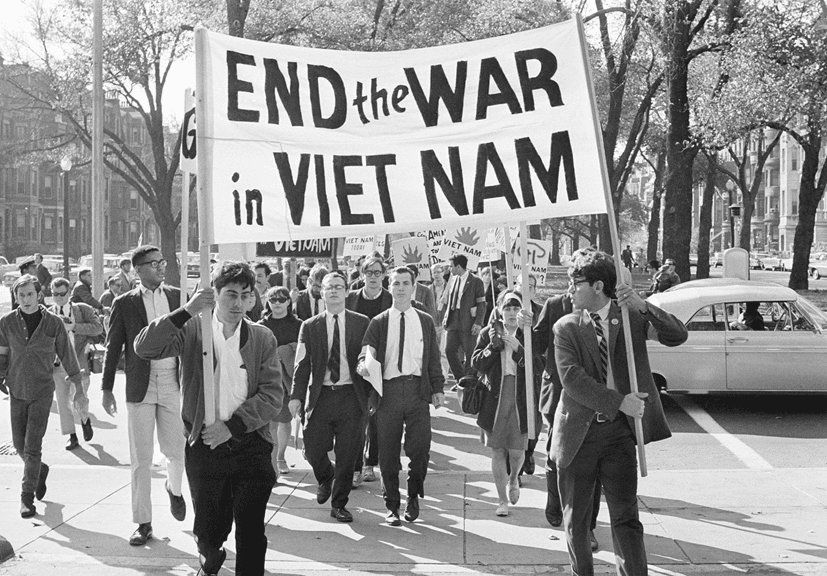
The Vietnam War marked another significant turning point in American views on foreign policy. When the United States began sending combat troops to Vietnam in 1965, only 24% said it was a mistake, while 61% said it was not, according to Gallup polling at the time. By the end of 1967, equal numbers said it was and was not a mistake. By 1973, 60% said it was a mistake, while only 29% said it was not.
Despite opposition to most foreign interventions, the RCOR poll finds that Americans still express a desire to help internationally under certain conditions. When asked whether the United States should intervene to turn a dictatorship into a democracy, 37% said it should intervene with strong allies, 17% said it should intervene even without strong allies, and 35% said it should not intervene. If a dictator is killing large numbers of their own people, 42% said the United States should intervene with allies, and 29% said it should intervene even without allies, while 17% said it should not intervene.
On issues more directly related to U.S. security, such as if an ally is attacked or to prevent a nuclear weapon from falling into the hands of terrorists, even fewer respondents said the United States should not intervene, at 8% and 10%, respectively.
This desire to help the world is also reflected in responses to statements about the U.S. role in the world, which were presented as unattributed quotes. Seventy-four percent agreed with John F. Kennedy’s statement, “The United States shall pay any price, bear any burden, meet any hardship, support any friend, oppose any foe to assure the survival and the success of liberty.”
Seventy-one percent agreed with Joe Biden’s statement from his 2024 remarks commemorating the 80th anniversary of D-Day: “America’s unique ability to bring countries together is an undeniable source of our strength and our power. Isolationism was not the answer 80 years ago, and it is not the answer today.” Seventy-seven percent of Republicans agreed with the statement, compared with 74% of Democrats.
However, when asked directly whether it would be acceptable for the United States to get involved in changing another country from a dictatorship to a democracy, only 24% supported doing so, while 56% said the United States should stay out of other countries’ affairs.
Democrats were much less likely to favor foreign intervention in this case, with only 16% supporting American involvement to change a dictatorship into a democracy, compared with 35% of Republicans.
State of Union
.