

Why the Midterm Math Is Starting To Favor Democrats
If history is any guide, Democrats will have a much better year than Republicans in the upcoming midterms. This is because historically the party out of power (currently the Democrats) almost always picks up seats in the immediate election after a presidential candidate of the opposing party (Donald Trump) is elected. This trend is so ingrained that Democrats to this day congratulate themselves for holding net Republican gains in the House of Representatives to “only 10” seats in the 2022 midterms when Joe Biden was president – even though control of Congress switched to the GOP.
Today, the political winds seem to favor Democrats on many metrics. For instance, 56.9% of Americans say the country is on the wrong track (according to the RealClearPolitics Polling Average). Americans unhappy with the direction of the country are ripe to vote for “change,” as is almost always the case.
More specifically, in Susquehanna Polling & Research’s most recent nationwide survey of likely voters conducted just before New Years, only 38% approved of the job Trump is doing as president (56% disapprove). The telephone survey was conducted 12/9-12/17 with a sample size of 1,200 likely voters. What is striking about this result is that in this same survey, 49% of Americans said they voted for Trump in 2024 election – consistent with his share of the national popular vote against Kamala Harris – yet only 38% approve of him now. This suggests buyer’s remorse for a significant number of voters.
A look under the hood at the crosstabs shows cracks in the Trump armor. CNN exit polling conducted immediately after the 2024 POTUS election shows Trump received 46% of the vote among independents. Yet in our latest SP&R national survey, only 28% of independents approve of the job Trump is doing.
Likewise, among Latinos, Trump received 46% of the vote in 2024 according to CNN. Yet one year into his second term only 33% of Latinos approve of the job he is doing. Why is Trump’s sagging approval rating important? Because in 2022, Joe Biden’s approval rating going into the 2022 midterms averaged 39% (according to media reports), and Republicans went on to flip control of the House of Representatives.
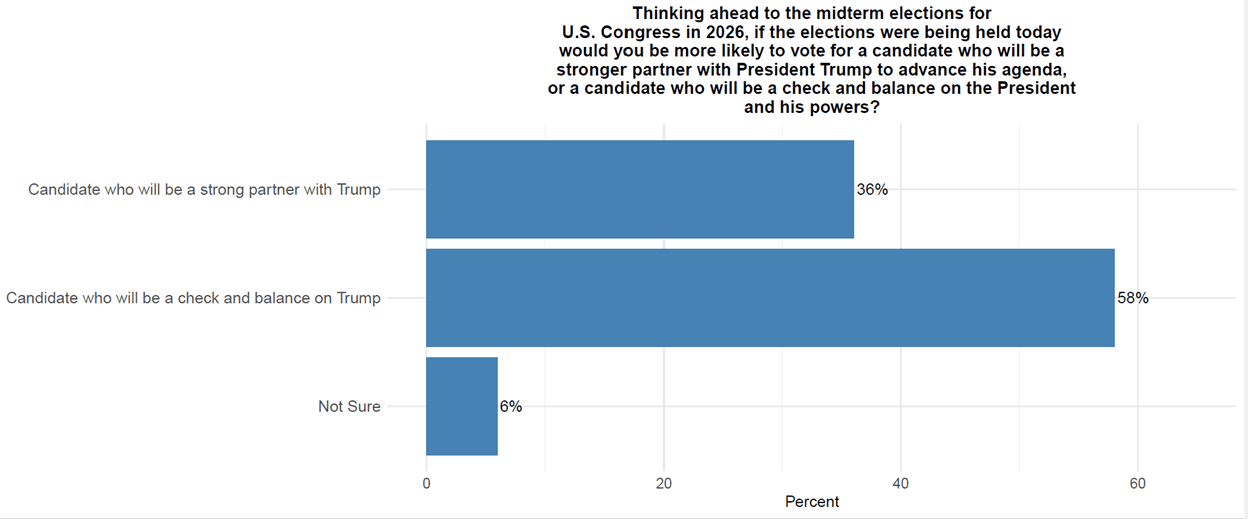
Perhaps an even more telling sign that congressional Republicans could be in trouble this year is that in a separate question asked in our SP&R national survey, 58% of Americans said they would be more likely to vote for a candidate for Congress who “will be a check and balance on Trump and his powers,” while only 36% prefer a candidate who “will be a strong partner with Trump and help pass his agenda.”
Taken at face value, these results portend a potential bloodbath for the GOP in the upcoming elections. Lately, Americans are tuning into a barrage of daily television news reports showing horrifying accounts of ICE raids in targeted U.S. cities in search of illegal immigrants, two ICE-involved shootings where protesters died, and a Trump regime that most Democrats believe is out of control and off the constitutional rails. To Democrats, Trump is power-hungry and needs to be reined in. So the fact that nearly six in 10 Americans prefer a congressional candidate who will serve as a roadblock to Trump’s powers makes sense.
A lot can change between now and November. Republicans say they are confident they have a winning message after two years of Trump policies. These wins include falling inflation, lower gas prices, an air-tight Southern border, and a strong stock market.
Still, Republicans are down by nearly 5 points in the congressional “generic” ballot according to the RCP Average (45.7% Dem v. 41.2% GOP), another warning sign trouble is just around the corner. And despite all the energy over gerrymandering, the Republicans’ cushion is incredibly narrow: their 220-215 margin remains the tightest in nearly 100 years.
But if our future polling shows that the mood of the electorate continues to favor a congressional candidate who can be a “check and balance” to Trump’s powers – brace yourself for what could be the second year of a blue wave that started in 2025 but will crest in 2026.
State of Union
.